

Do you know how much time is left on your Kardin Portal contract? Stay on top of renewal dates and...
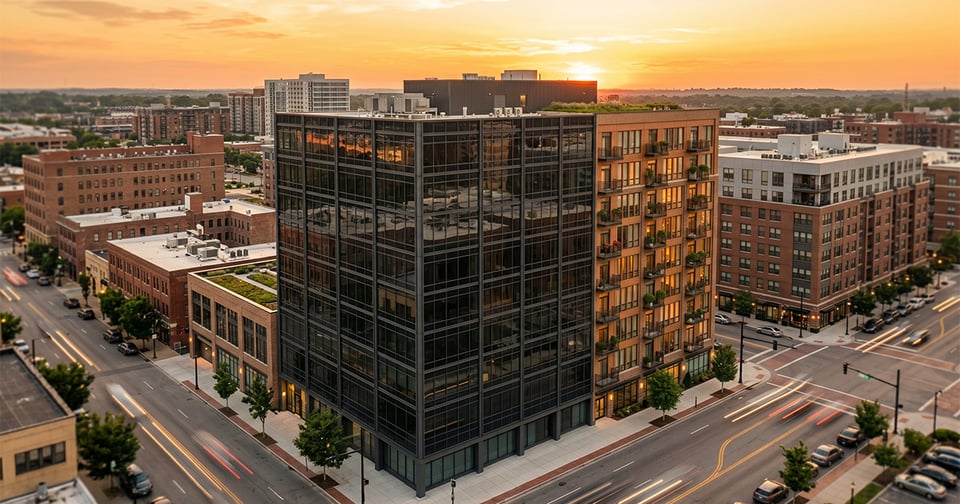
Adaptive reuse added another 19,700 units to the 2026 conversion pipeline. Turning the building into apartments is only the beginning. Rebuilding the operating model is where most teams are about to get caught short.
TL;DR
The 2026 office-to-apartment conversion pipeline just grew to a record 90,300 units, up 28% year over year and nearly four times where it stood in 2022. New York, Washington, and Chicago lead, but activity is broadening nationally, and office conversions now account for 47% of all planned adaptive reuse. With roughly $213 billion in U.S. office loans coming due by year-end, the wave isn’t slowing. The catch is that the construction work is the easy part. When an office becomes an apartment, the operating model, the chart of accounts, and the forecast all need to be rebuilt from scratch. Teams with a flexible budgeting platform will absorb that change. Teams still working in spreadsheets are in for a long year.
The pipeline just broke another record
According to RentCafe’s March 2026 report, 90,300 apartment units are now in the office-to-residential conversion pipeline, a 28% jump from last year and a 4x increase since 2022. Bisnow, Construction Dive, and The Real Deal all picked up the story, and for good reason. Adaptive reuse has officially moved out of the “interesting one-off project” category and into something closer to a market-defining trend.
The geography tells the story:
- New York leads with 16,358 units, more than double Washington, D.C., and more than three times Chicago or Los Angeles.
- Top follow-ups by pipeline size: Washington, D.C. (8,479), Chicago (4,360), Los Angeles (4,340), Dallas (3,966), Denver (2,991), Philadelphia (2,697), and Atlanta (2,642).
- In 12 of the top 20 metros, office conversions are the majority of planned adaptive reuse, including 82% in Dallas and Minneapolis, 64% in D.C. and Chicago, and 62% in New York.
- Nationwide, office conversions account for 47% of all future adaptive reuse projects.
And the runway is nowhere near exhausted. Roughly $213 billion in U.S. office loans, about a third of all outstanding office debt, comes due by the end of this year. Owners facing refinance conversations with a lower basis and softer fundamentals are going to keep asking the same question: does this building work better as something else?
The construction story gets the headlines. The operating story doesn’t.
Here’s the part most coverage skips. Converting a building from office to multifamily doesn’t just change the drywall. It changes every assumption in the underwriting.
Revenue stops looking like 5- and 10-year leases with fixed escalations and CPI bumps. It starts looking like 12-month lease terms, monthly turnover, concessions, bad debt, and seasonal absorption curves you may not have modeled before. Opex stops flowing through a tenant-reimbursable CAM pool and starts looking more like owner-paid utilities, unit-level turn costs, amenity programming, and a leasing office that runs year-round. Property taxes reset. Insurance reprices. Reserve assumptions that made sense for an office asset are quickly off by an order of magnitude once the same building is producing multifamily cash flows.
In accounting terms, the chart of accounts itself has to change. In planning terms, the forecasting rhythm has to change, from an annual budget with quarterly reforecasts to something much closer to a rolling operational view. And in reporting terms, the KPIs that used to matter, like occupied square footage, weighted-average lease term, and recovery ratio, get replaced by a new set: occupancy, effective rent, turnover, renewal rate, and NOI margin.
Any team that has spent the last decade refining its office CAM methodology, recovery logic, and capex program will still have most of that institutional knowledge. It just won’t apply to the converted building.
It isn’t one building. It’s a portfolio in motion.
Very few sponsors are converting a single asset in isolation. The more realistic 2026 portfolio looks like this: some towers fully converted and stabilizing as multifamily, some partially demoed and carrying construction-in-progress accounting, some still running as traditional office with declining occupancy, and a few in the “we haven’t decided yet” category.
That is the part legacy budgeting tools don’t handle well. A single asset might run as office through Q2, sit partially vacant during demolition in Q3, be in active construction in Q4, and re-emerge as a rent-roll-driven multifamily property midway through the following year. Your budget has to model all four of those states, and the rollups have to land cleanly at the fund level regardless of what any individual building is doing.
If your team’s answer to “we’re converting that tower” is “give us a week to rebuild the workbook,” you are going to spend 2026 rebuilding workbooks.
Why flexibility beats a template
This is the argument for purpose-built CRE budgeting that holds up best under pressure: not that it produces a prettier variance report, but that it lets you model an asset whose fundamental identity is changing, and still roll the number up cleanly at the portfolio and fund level.
A flexible planning platform should let you:
- Run parallel pro formas on the same building, office today and multifamily tomorrow, without duplicating the workbook.
- Change the chart of accounts and the KPI set at the asset level without breaking the portfolio rollup.
- Reforecast mid-year when the construction timeline slips, and keep the audit trail clean.
- Consolidate mixed-use, converted, and pure-play assets in a single view without manual cleanup.
That is the difference between a tool that digitized the old process and a tool that is ready for the next one.
Three questions for your next planning session
If you own or operate office assets in the metros leading the conversion wave, three honest questions are worth bringing to the table this week:
- Which assets in our portfolio are realistic conversion candidates in the next 24 months, and are we modeling the transition explicitly in our 2026–2027 forecast?
- Can our systems run an office pro forma and a multifamily pro forma on the same building, side by side, without duplicating the workbook?
- When a building changes use mid-year, how long does it actually take our team to rebuild the operating model and reforecast the rest of the year?
If the answer to any of those is “we’d need to start from scratch,” that is the real work of 2026. The conversion pipeline isn’t slowing down. The question is whether your planning process is flexible enough to keep up.
Sources
- Office conversions pipeline hits 90,300 units nationwide for 2026 (RentCafe via FMLink)
- Office-to-housing conversions grew 28% last year (Construction Dive)
- Office-To-Resi Conversions Up 28% From Last Year’s Record Levels (Bisnow)
- Office Conversions Hit 90K, Boosting Adaptive Reuse (CRE Daily)
- U.S. office-to-apartment conversions hits new high (The Real Deal)
- U.S. Real Estate Market Outlook 2026 (CBRE)
This article references third-party research and market commentary for informational purposes only. Kardin does not endorse or promote any specific investment strategies or external products mentioned. Kardin may use widely adopted third-party technologies on its website and internal operations, such as analytics and productivity tools, in the normal course of business.